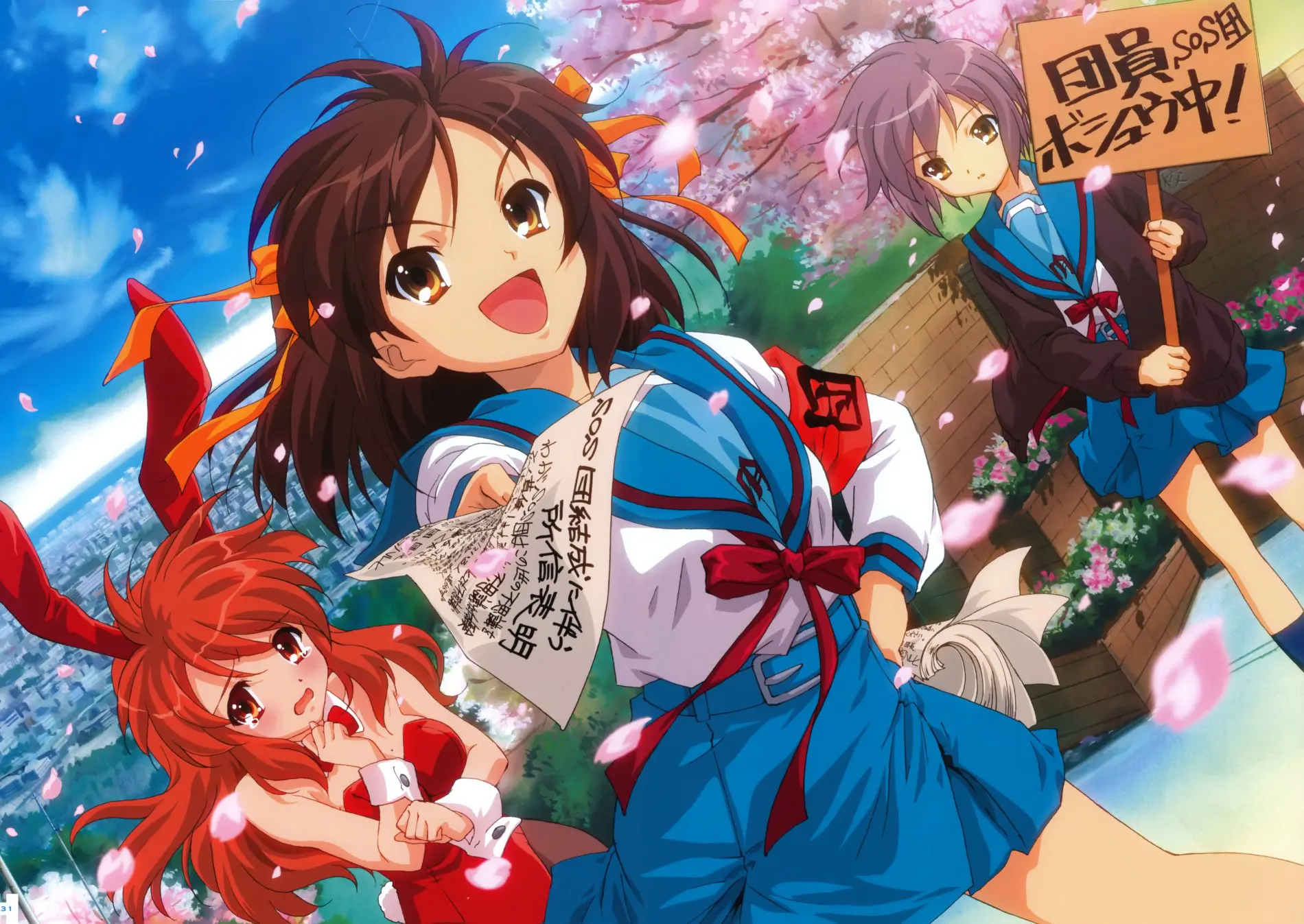
The Melancholy of Haruhi Suzumiya is one of the few anime where the watch order is part of the experience. When Kyoto Animation first aired it in 2006, it broadcast its 14 episodes deliberately out of sequence, starting with a student film that looks like a bad joke. In 2009 the show was re-aired in story order with 14 new episodes mixed in, including the eight-episode Endless Eight. Then a film, The Disappearance of Haruhi Suzumiya, finished the story in 2010. So there are three reasonable ways to watch it, and fans still argue about which is best.
This guide lays out all three and gives a recommendation. If you're new to the vocabulary of watch orders, our guide to how to watch anime in order covers it. Our automatic Haruhi Suzumiya watch order page lists the 2006 series, the 2009 series and the film as three entries in release order. What it doesn't say is that the 2009 entry repeats every 2006 episode, so this article tells you which episodes in it are new.
What you're working with
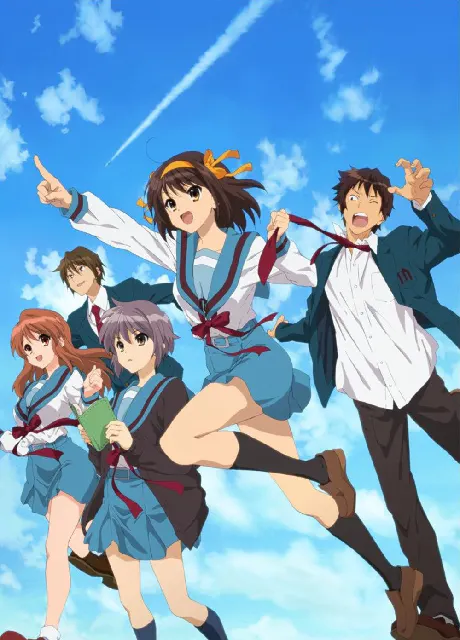
The Melancholy of Haruhi Suzumiya
TV · 2006 · 14 episodes · Kyoto Animation · 76% on AniList · Sub & dub
Comedy, Mystery, Sci-Fi
Haruhi Suzumiya is a high school girl who's bored by normal life and starts a club, the SOS Brigade, to look for aliens, time travelers and espers. The narrator, Kyon, is the only normal person she recruits, and he soon learns the other members are exactly what Haruhi wanted, and that Haruhi may be reshaping reality without knowing it. The series adapts Nagaru Tanigawa's light novels, and much of its reputation comes from how it plays with structure. If you're not sure what a light novel is or why so many anime come from them, our explainer on what a light novel is covers it.
The entries:
- The Melancholy of Haruhi Suzumiya (2006), 14 episodes
- The Melancholy of Haruhi Suzumiya (2009), 28 episodes: the 14 original episodes re-aired in story order plus 14 new ones
- The Disappearance of Haruhi Suzumiya (2010), a film that runs over two and a half hours
Option 1: the 2006 broadcast order
This is how Japan first saw it:
- The Adventures of Mikuru Asahina Episode 00
- The Melancholy of Haruhi Suzumiya Part 1
- The Melancholy of Haruhi Suzumiya Part 2
- The Boredom of Haruhi Suzumiya
- The Melancholy of Haruhi Suzumiya Part 3
- Remote Island Syndrome Part 1
- Mystérique Sign
- Remote Island Syndrome Part 2
- Someday in the Rain
- The Melancholy of Haruhi Suzumiya Part 4
- The Day of Sagittarius
- Live Alive
- The Melancholy of Haruhi Suzumiya Part 5
- The Melancholy of Haruhi Suzumiya Part 6
The six "Melancholy" parts are the main story, the first novel, and they're spread across the run so that the season ends on its climax. The other episodes are side stories from later in the school year, shown before you've seen how the club formed. The effect is a puzzle: you see the SOS Brigade's later dynamic first, and then the main story explains it.
The first episode is the famous hurdle. The Adventures of Mikuru Asahina Episode 00 is the club's amateur film, made by teenagers in-universe, with shaky camera work, bad editing and Kyon's commentary. It's meant to look bad, and it's funny once you know the characters, but as a first episode it confuses people. If you use this order, know that going in, and keep going to episode 2.
Good for: people who want the experience original viewers had, and who enjoy assembling a story. Not good for: anyone who finds a confusing start a reason to quit.
Option 2: chronological order (the 2009 broadcast)
The 2009 re-air, from April to October 2009, put all 28 episodes in story order. This is the order of the 2009 entry in our catalogue:
- The Melancholy of Haruhi Suzumiya Parts 1–6 (episodes 1–6)
- The Boredom of Haruhi Suzumiya (7)
- Bamboo Leaf Rhapsody (8), new
- Mystérique Sign (9)
- Remote Island Syndrome Parts 1–2 (10–11)
- Endless Eight Parts 1–8 (12–19), new
- The Sigh of Haruhi Suzumiya Parts 1–5 (20–24), new
- The Adventures of Mikuru Asahina Episode 00 (25)
- Live Alive (26)
- The Day of Sagittarius (27)
- Someday in the Rain (28)
The new episodes aired between May and September 2009. Watched this way, the main story comes first and everything makes sense the first time, and "Episode 00" turns up right after The Sigh, the five-episode story about the club making that film, so you understand why it's so bad.
Good for: first-time viewers who want a clear story. Not good for: anyone who wants the six-part main story to build to its ending; in this order, the main climax arrives at episode 6, and the rest feels like a long epilogue.
Option 3: the hybrid most fans suggest
A popular recommendation, especially from people who watched in 2006, is to do both:
- Watch the 2006 series in broadcast order (14 episodes).
- Then watch only the new 2009 episodes, in this order: Bamboo Leaf Rhapsody, Endless Eight, The Sigh. In the 2009 entry, those are episodes 8, 12–19 and 20–24.
- Then watch The Disappearance of Haruhi Suzumiya.
This keeps the 2006 puzzle, avoids watching 14 episodes twice and gets you to the film with everything it needs. It's what we'd suggest for most people. If you know you hate being confused, use chronological order instead. None of these is wrong; it's a real disagreement, not a case of one "correct" order and two mistakes.
One episode matters more than it looks: Bamboo Leaf Rhapsody is a short time-travel story that The Disappearance builds on directly. Whatever order you choose, don't skip it.
Endless Eight: what to do with it
Endless Eight is eight episodes of the same story. The SOS Brigade is stuck in a loop of the last two weeks of summer vacation, and each episode shows another repetition, with new animation, different outfits, different camera angles and small changes in dialogue, but mostly the same events. It's a deliberate attempt to make the audience feel the loop. When it aired one week after another in 2009, many viewers were furious. It's still the most controversial decision in the series.
Common fan advice, which isn't an official instruction, is to watch Part 1, Part 2 and Part 8: the first loop, the one where the characters start to notice, and the one where they break out. That gives you the story and the ending. Watching all eight in a row is the intended experience, and some people find it fascinating rather than tedious, especially if you look for the differences. If you plan to skim, skimming Parts 3–7 is the place to do it.
The Disappearance of Haruhi Suzumiya (2010)
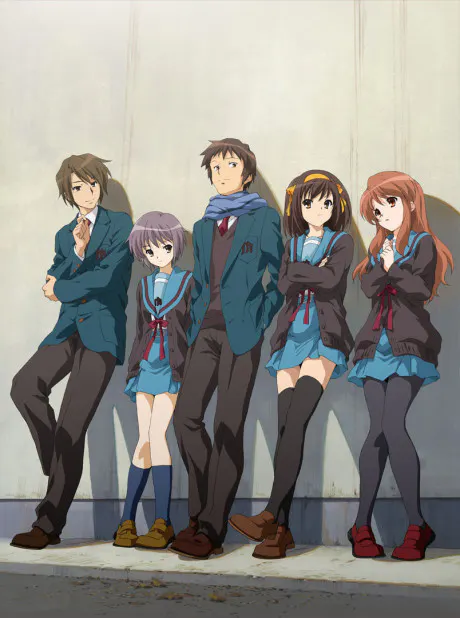
The Disappearance of Haruhi Suzumiya
Movie · 2010 · Kyoto Animation · 86% on AniList · Sub & dub
Drama, Mystery, Sci-Fi
The film, released in Japan on February 6, 2010, adapts the fourth novel and is widely considered the best thing in the franchise. In mid-December, Kyon arrives at school to find that Haruhi has never existed, no one remembers the SOS Brigade, and the other members are ordinary students. It's a slower, quieter story than the TV series, and it's where Kyon finally has to decide what he wants. It's directed by Tatsuya Ishihara and Yasuhiro Takemoto at Kyoto Animation. Watch it last, after Bamboo Leaf Rhapsody and the rest; the film assumes you know the whole series.
Its time-loop and alternate-reality ideas are why the franchise often shows up on lists of mind-bending anime and time travel anime.
How long each option takes
All the TV episodes run about 24 minutes. The film is the long part:
- 2006 broadcast order: 14 episodes, about 5 and a half hours. This is the minimum to get the main story.
- Hybrid: 14 episodes, then 14 new ones, then the film, about 14 hours in total. If you watch only three parts of Endless Eight, take off about two hours.
- Chronological: the 2009 entry's 28 episodes, then the film, about the same 14 hours, without any repeats.
The only way to waste time is to watch the 2006 series and then all 28 episodes of the 2009 entry. Half of those are the same episodes, re-aired.
Sub or dub
Haruhi has a complete English dub covering both seasons and The Disappearance, with Wendee Lee as Haruhi and Crispin Freeman as Kyon. Kyon's narration carries the series, and it's a large share of the dialogue, so pick whichever version you find easier to listen to for long monologues. Our guide to sub vs. dub covers the general trade-offs.
Who it suits
Haruhi suits viewers who like dry narration, school comedy that turns into science fiction and stories that play games with structure. It's also a good way to understand a lot of mid-2000s anime culture: the dance from its ending sequence was copied everywhere. It's not for anyone who finds a self-centered lead tiring, because Haruhi is often unpleasant on purpose, and the series takes its time showing why the others put up with her.
Spin-offs
- The Melancholy of Haruhi-chan Suzumiya (2009, 25 short episodes) is a gag spin-off with chibi versions of the cast. It's a parody of the main series, so watch it after it.
- The Disappearance of Nagato Yuki-chan (2015, 16 episodes) is a romantic comedy set in the alternate world from The Disappearance, with the quiet club member Yuki Nagato as the lead. It spoils the film's premise, so watch it only after the film.
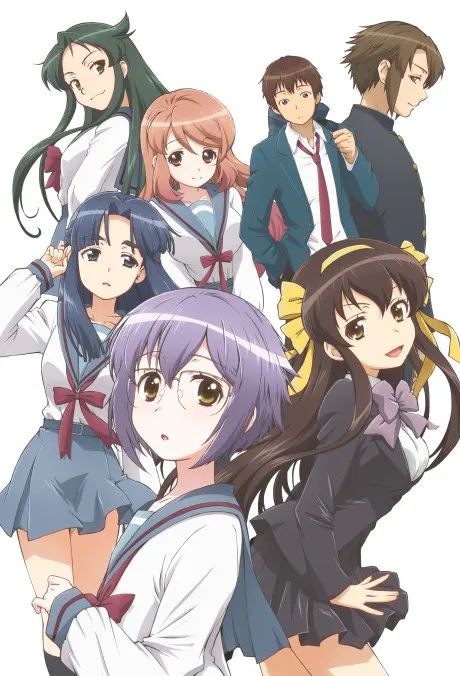
The Disappearance of Nagato Yuki-chan
TV · 2015 · 16 episodes · Satelight · 64% on AniList · Sub & dub
Comedy, Romance, Slice of Life
What hasn't been animated
The anime covers the first four novels, plus short stories from later volumes. The novels set after The Disappearance, including The Dissociation and The Astonishment, have never been animated. If you finish the film and want the rest of the story, the novels are where it continues.
If you like this
Haruhi is a big part of why Kyoto Animation became famous, and our guide to the best Kyoto Animation anime covers what the studio made next. For another series where the watch order is a puzzle in itself, see our Monogatari watch order and our Kara no Kyoukai watch order, both of which have the same broadcast-versus-chronological debate. For a different kind of order problem, our Gintama watch order sorts out a series with confusing season names. You can also browse for other shows from the same era, or sample first episodes on Discover.